
Buying a New Flat From a Builder or a Resale Flat in Noida
A builder flat and a resale flat in the same sector are two different purchases. What changes: the tax, the wait, the paperwork and who pays the broker.
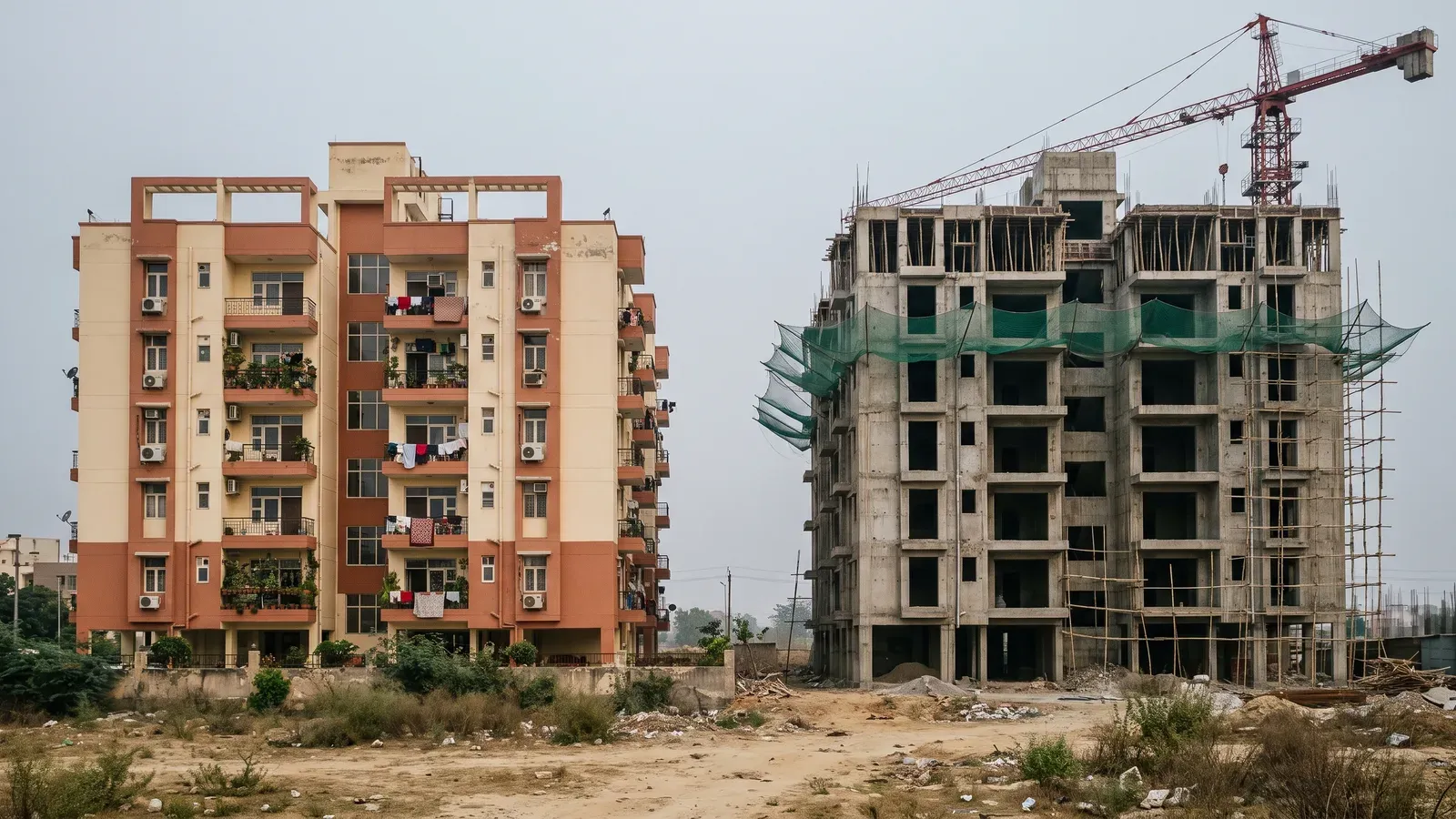
Two flats, roughly the same money.
The first is on the eleventh floor of a society in Greater Noida West where people have lived for six years. You can go at eight on a Tuesday evening, wait for the lift with everyone else and stand in the actual room. The owner is moving to Bengaluru and wants to be done by October.
The second is in a project two kilometres away that today is a boundary wall, a marketing suite and a sample flat lit the way no flat ever is. Possession is a date printed in an agreement.
Most people choose between these on feel. New feels safer because it is new. Resale feels safer because it is standing there. Neither feeling is a reason. Here is what actually changes.
The tax on top is not the same tax
A flat still under construction attracts GST. Right now that is 1% for affordable housing, which in Delhi NCR means a carpet area up to 60 square metres and a price up to ₹45 lakh, and 5% above that. Neither rate carries input tax credit, so none of it comes back to you. The GST 2.0 revision of 22 September 2025 left both numbers where they were, whatever the posts claiming a 2026 change say.
A completed flat sold after the project has its occupancy certificate attracts no GST at all. Not a lower rate. None. On a ₹1 crore flat that is a ₹5 lakh gap between two similar homes in the same sector, and it shows up on neither price list.
Taking over somebody’s booking in a project still going up is a third case. The builder’s GST runs on the instalments left to pay, and there is a transfer fee. Ask what it is before you agree a price.
Stamp duty is the same rate, at a different moment
Stamp duty in Uttar Pradesh does not care who is selling. It is 7% for a male buyer, 6% for a woman buying in her sole name and 6.5% for a man and woman buying jointly, plus 1% registration. It is charged on the circle rate or the transaction value, whichever is higher, so agreeing a low price does not take it below the government’s number for that locality. The 1% concession for women was capped at ₹10 lakh properties until the UP cabinet raised the ceiling to ₹1 crore in July 2025.
What changes is when you pay. On a resale the sale deed is registered now, so the duty falls due now. On a builder purchase it is usually registered at possession, years out, at whatever the circle rate is then. Neither is better. It is a large bill you have not paid yet, and people forget to keep the money for it.
One of them you can stand in
A resale flat is a fact. Turn the tap on at seven in the morning on the eleventh floor and you find out what the water pressure really is. You can see the damp patch in the second bedroom, count the lifts, look at the car park at 9pm when everyone is home, and ask the neighbour whether the maintenance charge is actually being collected.
A new launch is a brochure, a sample flat and a promise. Not an accusation, just the nature of the thing. The sample flat is built to sell and is usually not in the tower you are buying in, which is why we have written before about standing in your own unit first. If the finish and the neighbours matter to you more than anything else here, that argument is over and resale wins it.
Waiting costs money, and a delay costs more
A new launch has a delivery date, and delivery dates in this state have a history. UP-RERA has taken in close to 60,000 complaints since it was set up, and delayed possession runs through a large share of them.
That is not a reason to avoid under-construction property. It is a reason to read the registered completion date on up-rera.in instead of the one you were told out loud, and the delay clause instead of the brochure. Then do the arithmetic nobody does. Paying rent and construction-linked instalments together means paying for two homes for as long as the project runs.
The registry problem, which runs the other way
Resale is not the safe side of this trade. On land allotted by the Noida and Greater Noida authorities, a flat can be finished and lived in for years and still have no registered sale deed, because the builder owes the authority money and registry stays blocked until it is paid. In Greater Noida West alone more than 50,000 registrations are stuck, across 88 completed societies with around 4.5 lakh residents (The Daily Jagran, 2 February 2026).
A seller can hand you keys, a possession letter and an allotment letter and still not be able to give you title. Ask for the registered sale deed in the seller’s own name first. If it does not exist, get the reason from the authority rather than the seller. We have written separately about what to check before you offer on a resale flat in Greater Noida West, and our legal checklist covers the rest of the title work.
How the money has to leave your account
A builder purchase is usually staged. You pay a booking amount, then instalments as each stage of the building is finished, over years. That suits somebody whose savings are still arriving.
Some launches offer a subvention arrangement, where the bank releases the loan to the builder up front and the builder pays your interest until possession. Be careful. The National Housing Bank told housing finance companies to stop funding these in 2019 after reported fraud, and the Supreme Court has been hearing petitions from NCR buyers whose builder then stopped paying, ordering that no coercive action be taken against them meanwhile. The loan is drawn against a building that does not exist yet, and the risk on your credit record is yours.
A resale runs on a shorter clock. The seller has usually committed to their next move and wants the full amount within weeks, so your sanction has to be ready. If they have a loan of their own there is a payoff and a no-objection step with their bank first. Stamp duty and registration come out of your own savings either way, because no lender funds them.
Where the price actually moves
A builder’s list price rarely moves as a price. It moves as an offer: floor rise waived, a parking slot included, club charges dropped, the payment plan shifted. It moves most when there is stock to clear at the end of a phase. You are negotiating against the builder’s inventory position, and so is everybody else.
A private seller’s price moves for a reason personal to them. A transfer, a settlement, a bigger flat already booked. One flat, one seller, so it turns on why they are selling and by when. Ask that early. It tells you more than any rate per square foot will.
What RERA does for you in each case
RERA registration is about the project and the builder. It gives you a registered completion date, money held in a separate account, a declared carpet area and a public complaints record you can look up at up-rera.in. On a new launch that is genuinely useful, and it is why nothing goes on our list without a live registration.
It does much less on a resale of a completed flat. That is a private transaction between you and an owner, and RERA is not standing behind it. What protects you is the title work: the sale deed, the chain of ownership, the encumbrance position, the society dues and the occupancy certificate. A resale of a booking still under construction sits in between, so have the transfer recorded with the builder rather than on a side agreement.
Side by side
| New, from a builder | Resale | |
|---|---|---|
| GST | 1% affordable, 5% otherwise, no input tax credit | None after the occupancy certificate |
| Stamp duty and registration | Same UP rates, usually paid at possession | Same UP rates, paid now |
| What you can inspect | Sample flat, brochure, a site under construction | The actual flat and society, at the hour you would use it |
| When you move in | A date in the agreement | Now, once the paperwork clears |
| Who you sign with | The builder, on the builder’s standard agreement | A private owner, on a sale deed between two people |
| How you pay | Usually staged against construction | Usually the full amount in a short window |
| Main risk | The date slips | The title or the registry is not clean |
| What RERA covers | The project, its date and its escrowed money | The project, not your private sale |
| Who pays our fee | The builder | The seller |
Which situation points which way
Neither option wins in general. Here is the useful version of “it depends”.
Resale suits you if you need to move within a few months, if you cannot pay rent and instalments at the same time, if you want to know exactly what you are getting before you pay, or if that GST line matters to your budget.
A builder purchase suits you if your money is arriving over the next few years rather than sitting in an account today, if you want one seller and a standard agreement with no chain of previous owners to trace, or if you want a project or a layout the resale stock in that sector does not have.
Check this first if you are looking at resale anywhere in Greater Noida West: the registry status of that society. It can settle the whole question on its own.
Who pays us, and why you should know
You never pay us, on either kind of deal. On a builder project the developer pays us, and that fee already sits inside the price you are quoted, which is the same price you would get walking into the site office yourself. On a resale the seller pays the commission. Trade sources put the usual developer-side fee somewhere between 1% and 5%, and we are not going to quote our own number here. That is trade practice, not regulation, and no RERA rule we are aware of requires a channel partner’s commission to be disclosed to a buyer at all.
Now read the shape of it. On a new launch we are paid by the party selling the flat. On a resale we are paid by the party selling the flat. In both cases the person paying us is not you. That does not make our reading of a cost sheet wrong, but it does mean our interests and yours are not automatically the same, and anyone in this business who tells you otherwise is selling you something.
So use us the way you would use anybody in that position. Ask what is wrong with a project before you ask what is right. Get the price, the payment schedule and the possession date in writing from the builder or the seller, and look the registration up yourself. If we ever discourage any of that, we are the wrong people to work with.
On a builder deal we get you the current price list, what is genuinely still unsold in a tower and a site visit, then read the cost sheet and the agreement with you line by line. The projects page is the whole list. Resale is different work, with no builder price list and the title and registry checks as the job. It does not get a listing page here, so ask us what we have. The fee and coverage answers are on the FAQ, and how we work is on the about page.
If you want a straight answer on which of these fits your situation, tell us the situation. If neither fits, we will say so.
Written for general guidance, not as legal, tax or financial advice. Check any project's registration and paperwork yourself before you pay anything. We are happy to walk through it with you.